Scaling local experiments: how DSW’s The Edit and Salesforce-Google Cloud tools can turn four pilots into repeatable growth
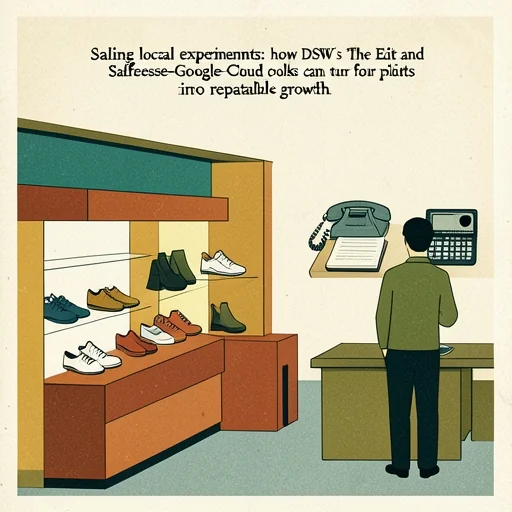
Local retail has been under pressure to prove that small-format experiments pay off. This article explains how DSW’s plan to open The Edit in four existing stores. The plan will happen this fall and it connects with the Salesforce and Google Cloud partnership announced at Dreamforce 2026. The article also explains how both moves can be harnessed for scaling local strategies across stores. Together, these initiatives aim to enable repeatable growth across stores. The piece shows how a four-store pilot, AI services like Gemini Enterprise, and infrastructure like Hyperforce work together. These elements create a loop from inventory to ad targeting that marketers can use.
Tie pilots to data that reacts in real time
DSW will test a curated affordable-luxury shop-in-shop called The Edit in four existing locations this fall, keeping capital low while measuring customer response and unit sales. Small pilots reduce capital risk while generating actionable retail signals. For a local business, that means treat each shop-in-shop as a data source: sales, conversion, and assortment pull should feed the marketing stack so creative and bids adapt fast.
Salesforce’s headless architecture on Google Cloud promises to pull customer, inventory, and campaign signals together through Gemini Enterprise and Hyperforce on Google Cloud. Kevin Ichhpurani said enterprise AI only pays off when agents understand business context and act on it. He said this ties directly to the need for pilots to produce clean context. A shared cloud platform brings CRM and point-of-sale signals into one place.
A shared cloud platform brings CRM and point-of-sale signals into one place.
Design experiments so AI can close the loop from search to shelf
DSW’s Edit is designed to test curated assortments inside current footprints, and local marketers should treat it as a live lab for messaging, pricing, and pickup flows. Track SKU-level sales and feed those signals to your CRM so ads show only available items. Linking SKU level pilot data to CRM lets AI improve ad targeting and commerce That reduces wasted ad spend when stock is low.
The Salesforce-Google Cloud tie adds tools that make that linkage practical. Commerce Cloud integration, starting this Fall, will let merchants connect search discovery to purchase paths, while Tableau feeding into Gemini Enterprise standardizes analytics. Velia Carboni observed that AI changes how consumers discover products and where they buy them. She said this means search-linked commerce must be part of the pilot design. Make search-linked availability a primary KPI for local tests.
Make search-linked availability a primary KPI for local tests.
Move from trial to repeatable growth with staged migration
To scale a four-store pilot into many locations, plan the integration before launch: inventory feeds, point-of-sale events, and CRM sync must be mapped so audiences and bids update automatically. Meir Amiel said the change is the infrastructure underneath customers, not the trust they’ve built, signaling that migration can preserve security while adding capacity. Preserve customer trust while changing infrastructure underneath. For local chains, that lowers the barrier to automated checks and AI-driven summaries.
Operationally, expect work on data cleanup, compliance, and staff training to use AI workflows. Small businesses with existing Salesforce or Google integrations should audit where customer and inventory data live now and run staged moves. Start by measuring the pilot, feed those measurements to the shared cloud platform, and let AI translate them into better local reach and conversion. Turn each pilot store into a repeatable playbook for the next location.
Sources:
Related articles
-
 Local marketing: linking programmatic DOOH to store sales Local marketing has shifted from flyers and signage to coordinated digital paths that end at a street-level door. Read article
 -
 Apple Maps ads and AI demos boost local visits and sales This article looks at Apple Maps ads and AI product demos and explains how small businesses can use both to drive visits and sales. Read article
 -
 Voice AI and Short-Form Video Playbook for Local Businesses Local marketing is splitting its energy between two hard technical problems: producing persuasive short-form video and handling every inbound customer… Read article
 -
 Authentic Communication 2026: 3 Changes to Boost Local Business Read on to apply the principle of authentic communication 2026 to your store, restaurant, clinic or small business. Read article